Block Puzzle: How the Combo Really Works and How Pieces Are Dealt
Published by the Havfun team
Block Puzzle looks like a game of luck. Three pieces arrive, you fit them where you can, and sooner or later a piece turns up that has nowhere to go. But the pieces are not dealt blindly and the score is not counted the way most players assume.
Both have rules, and both can be used.
How Points Are Counted
Placing a piece scores nothing. Points come only from clearing lines: 10 points for each line, multiplied by your combo. A full row is one line and a full column is another, so a piece that completes a row and a column together scores twice.
The combo goes up by one every time a piece clears at least one line, and it has no upper limit. Your first clear is worth 10 per line, your second 20, your third 30.
| Single-line clears in one combo | Points |
|---|---|
| 4 | 100 |
| 6 | 210 |
| 8 | 360 |
| 10 | 550 |
| 13 | 910 |
Score only matters on the 77 levels that set a target score. On the 174 gem levels it is just a number, and the game has no stars.
Three Misses, Not Three in a Row
Here is the part that is easy to get wrong. The game counts every piece you place that clears nothing. When that count reaches three, the combo goes back to zero and the count starts again.
A clear does not reset the count. So the combo is not lost by three empty placements in a row. It is lost on your third empty placement in total since the last reset, however many clears came in between. Empty placements you make before your first clear count as well.
- Clear, clear, miss, clear, miss, clear: the combo is at 4 and you have used two of your three misses.
- One more miss, at any point, and the next clear is back to 10 points per line.
- After a reset you get a fresh allowance of two misses.
On a score level, think of each combo as a run with two spare placements. Spend them on pieces that set up several lines at once, then clear on one piece after another.
The count carries on when you continue with coins. It only starts fresh at the beginning of a level or on a retry.
How Each Hand Is Dealt
A new hand of three arrives only when all three slots are empty. The pieces are drawn from 18 shapes, and they are not all equally likely. The seven most common are the two-by-two square, the three-cell corner, the three-cell lines in both directions, one L, one T and the Z. The single cell and the two-cell pieces come up less often, and the three-by-three square is the rarest shape in the game.
More importantly, the hand is checked against the board as it stands:
- The middle piece is always one that fits somewhere on the board at the moment it is dealt.
- The first piece is drawn by chance. If it turns out not to fit, the third piece is chosen so that it does.
- The first hand of a level always fits, and its three pieces are all different.
So at least two pieces of every hand can be placed when the hand arrives. You are never dealt a dead hand. A level is lost when the pieces you place first take the room the others needed. Before you put down the first piece of a hand, find a home for the other two.
Two facts about the shapes are worth remembering. There is a five-cell line, but only a vertical one, and it appears from level 3. Keep a column with five free cells in a row for it. There is no horizontal five and no four-cell line at all, so a long gap across a row will never be filled by one piece.
Gem Levels
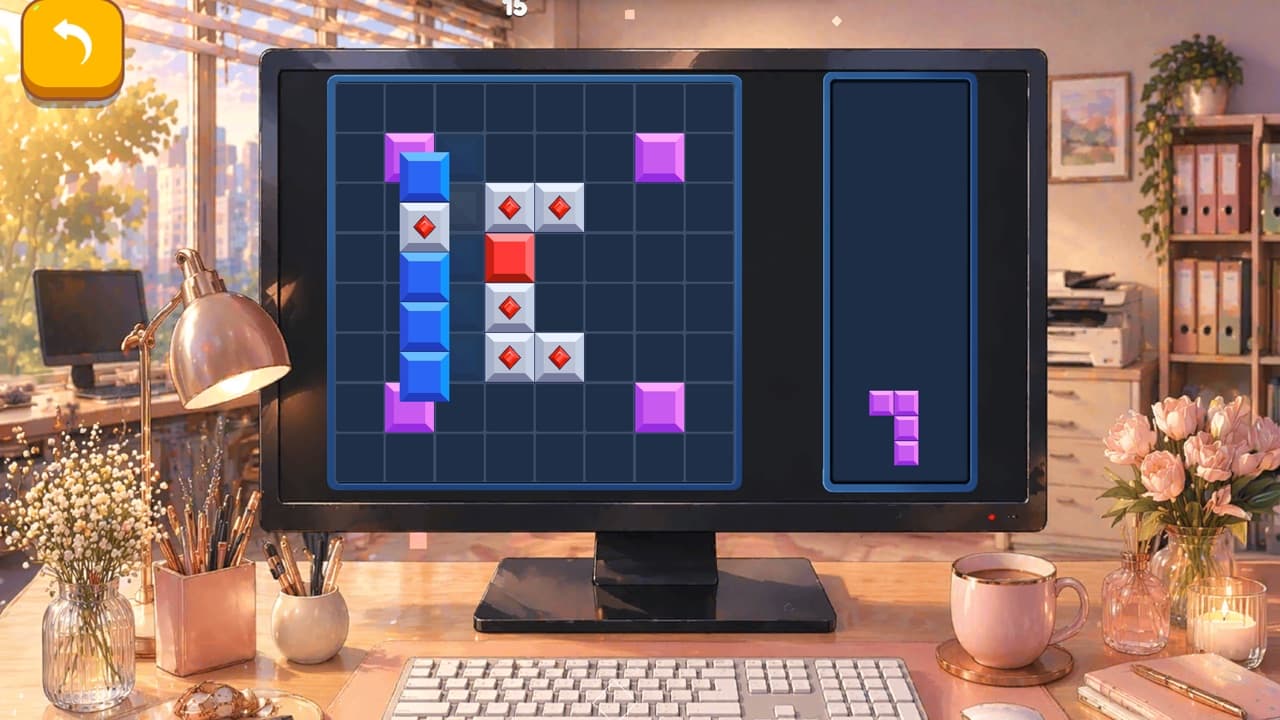
On a gem level you collect gems by clearing the lines they sit on. Some gems are on the board at the start, and the rest arrive on the pieces you are dealt: each new piece has a one-in-three chance, for every kind of gem you still need, of carrying one or two of that kind.
The game keeps count of the gems that are already on the board and in your hand, and it never deals more than the level requires. That has a useful consequence. Every gem you see is one you need, and no spares are coming. A gem placed in a row you can't complete is a gem you will have to dig out later.
- Place gem pieces into rows or columns that are already close to full.
- Don't park a gem in a corner pocket to get the piece out of your hand.
- Finishing the goal wins the level even if none of your remaining pieces fits, so the last gem is worth a risky placement.
Timed Levels
37 of the 251 levels have a clock. Thirty of them give you 120 seconds. Four give only 60: levels 126, 136, 224 and 247. Level 218 has 130 seconds, level 231 has 180 and level 243 has 190.
Timed score levels ask for far less than untimed ones. Level 126 wants 150 points in 60 seconds and level 224 wants 100, while the untimed targets climb as high as 960 on level 236. On a timed level a short combo is enough, and speed matters more than the perfect setup. The clock stops while the settings menu is open.
Almost every level is played on an 8×8 board. The exceptions are level 3, which is 9×9, and level 247, which is 6 rows by 8 columns.
Coins and Continues
When no piece fits or the clock runs out, you have 5 seconds to continue for 15 coins. The board stays as it is, you get three new pieces that are all guaranteed to fit, and a timed level keeps its remaining time or is set to 60 seconds if it had run out. You can continue as often as you can pay.
Coins do not come from clearing levels. You start with 20, and the rest come from two places on the start screen:
- The daily bonus pays 2, 10, 20, 30, 40 and then 80 coins over six visits. It moves on one step for each day you open the game and does not go back to the start if you miss a day.
- The lucky wheel has six wedges worth 1, 2, 3, 6, 10 and 20 coins. One spin a day is free and each extra spin costs 10 coins, which only two of the six wedges pay back.
There are no lives, so a failed level costs nothing and can be retried at once. A level finished with a coin continue still unlocks the next one, but it does not count on the leaderboard, which records the highest level you have cleared without continuing. You can replay it later for a clean clear.