Fruit Mixer: How Customers Pay and How to Earn Stars in the Career
Published by the Havfun team
Fruit Mixer looks like a game about getting orders right. It is really a game about getting them out fast, because the speed of a sale changes how much it is worth. Once you know how the bill is added up, the career stages become a matter of arithmetic.
What a Customer Pays
A served customer pays three things: the price of the juice, a speed bonus and a tip.
- The juice price is between $40 and $120, depending on which of the 14 juices was ordered.
- The speed bonus starts at the customer's patience in dollars and falls by $1 every second. There are eight customers, and their patience runs from 25 to 75 seconds.
- The tip is $2 if you own the Seat, $5 for the Juke box and $8 for the Flowers, $15 with all three.
The detail that matters is when the bonus starts to fall. It is counted from the moment the customer walks in at the edge of the screen, not from the moment they sit down, so a few dollars are gone before the order is even shown. And it keeps falling past zero. A customer served very late pays less than the price of the juice.
The most a single customer can pay is $210: the dearest juice, the most patient customer served instantly and every decoration bought. An ordinary sale, served within a few seconds, is nearer $110.
Blend Before They Order
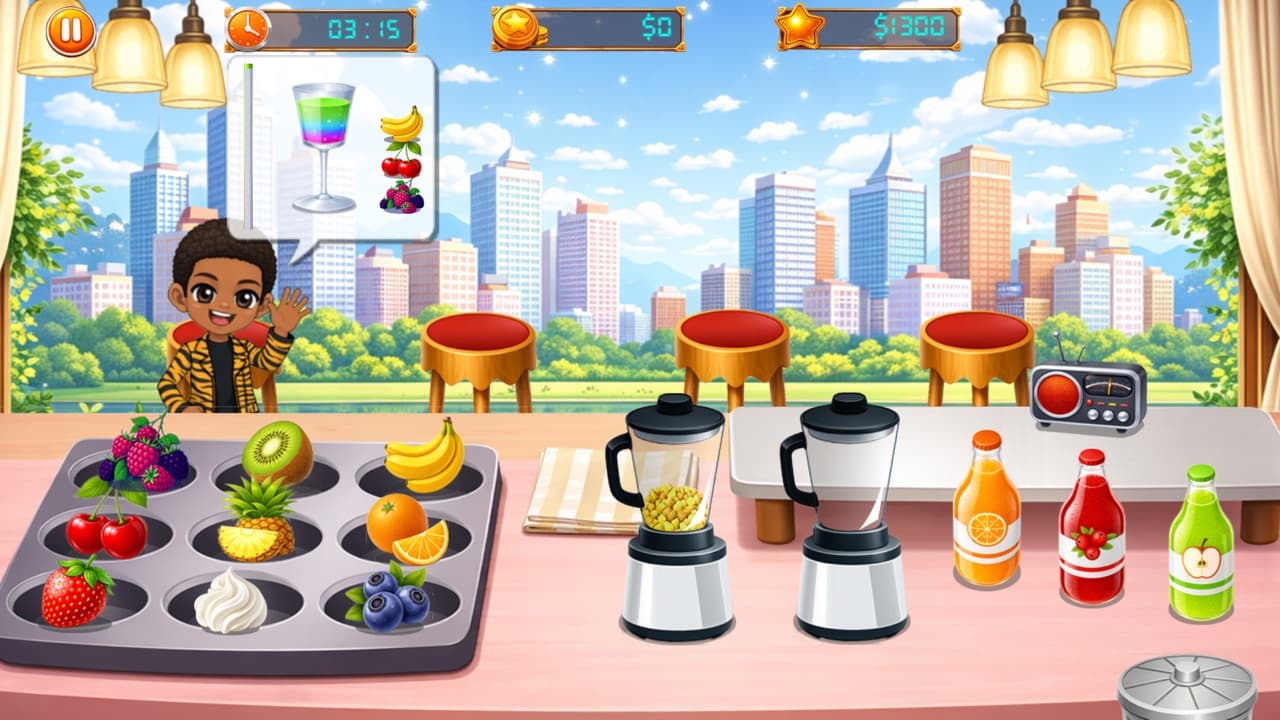
Blending takes 6 seconds, which is $6 off every sale if you start after the order appears. You don't have to. A blender will make a juice whether anyone has asked for it or not, a finished cup never goes off, and a cup isn't tied to the customer you made it for. Anyone whose order matches will take it.
You have two blenders on every stage. Keep both of them holding a finished juice that is on the stage's menu, and serve from stock.
- Stage 1 has only two juices on the menu. Make one of each, and the next order is always ready whatever it is. Stage 6 works the same way.
- On stages with a longer menu, every juice on it is equally likely to be ordered. Keep any two in stock and refill a blender the moment it is empty.
- A blender takes up to four ingredients, and the order you add them in doesn't matter. The button appears once there are two.
- You can't move or empty a blender while it is running, so check the ingredients before you press the button.
A wrong mix shows as a failed cup when the blending ends, before you hand it over. Throw it away. Emptying a blender into the bin is free, while handing a wrong cup to a customer loses the cup and the sale.
One small timing rule is worth knowing. Pouring from one of the three juice bottles stops you picking up a cup from either blender for a second and a half. Pour first, then serve.
The Eight Stages
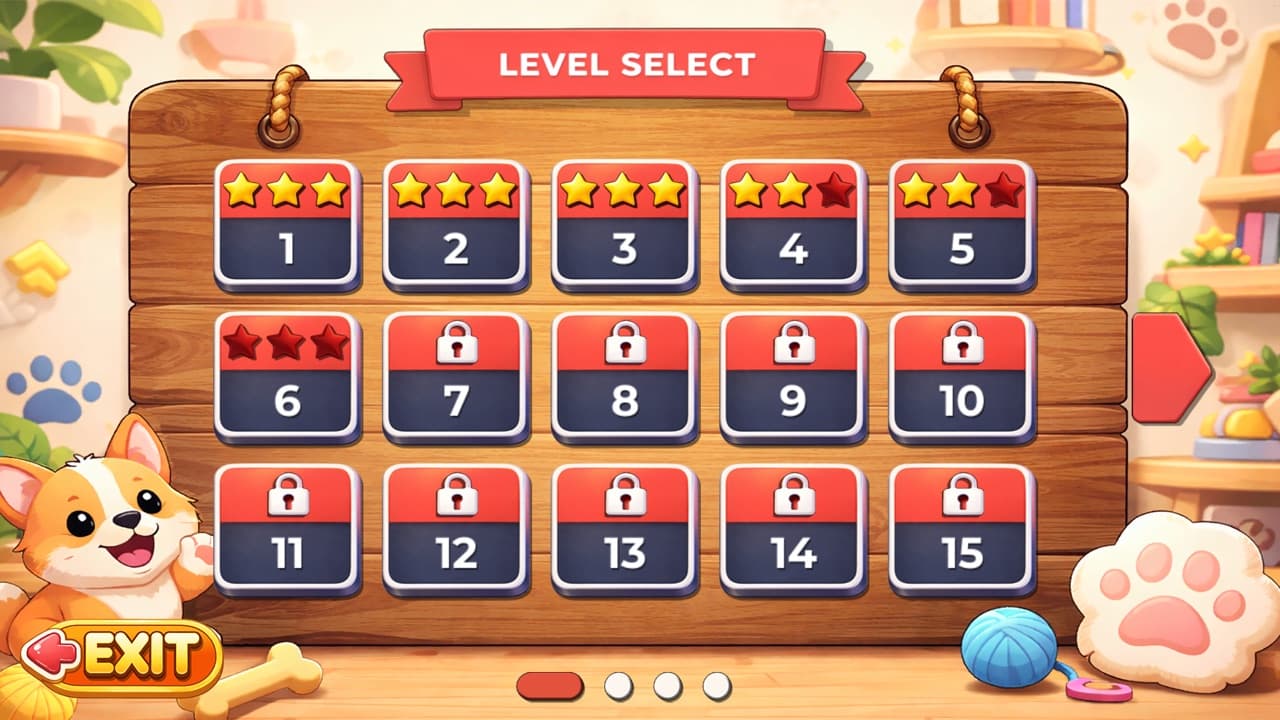
A stage is cleared the instant your earnings reach the target. Stars depend on the clock at that moment: more than 60 seconds left for three, more than 30 for two.
| Stage | Target | Time | Juices on the menu | Candy |
|---|---|---|---|---|
| 1 | $1,000 | 200 seconds | 2 | No |
| 2 | $1,300 | 200 seconds | 3 | No |
| 3 | $1,500 | 180 seconds | 4 | Yes |
| 4 | $1,500 | 240 seconds | 5 | Yes |
| 5 | $1,500 | 360 seconds | 7 | No |
| 6 | $1,500 | 120 seconds | 2 | Yes |
| 7 | $1,500 | 400 seconds | 9 | Yes |
| 8 | $1,500 | 600 seconds | 14 | Yes |
Customers arrive at a fixed pace. The first comes 2 seconds in, and after that a new one appears every 11 seconds as long as one of the four seats is free. That sets a ceiling on every stage, because you can only sell to the customers who have arrived.
For three stars on stage 1 you must reach $1,000 inside 140 seconds, by which time 13 customers have come in. That is $77 each, which is comfortable. Stage 3 is much tighter: $1,500 inside 120 seconds from 11 customers is $136 each, close to the best an average sale can be. Stages 5, 7 and 8 have so much time that three stars need only $30 to $55 a customer.
Stage 6 is the exception. Only six customers can arrive in its first 60 seconds, and six customers at the $210 maximum make $1,260. Three stars are out of reach there, and two would take an unusually patient run of customers. Treat stage 6 as a stage to clear, and collect your stars elsewhere.
Candy
Candy refills a customer's patience bar and keeps them from walking out. It does not bring back the speed bonus, which goes on falling. You start with 5, a candy is spent the moment you use it even if you then fail the stage, and it can't be used on stages 1, 2 and 5.
A stage where you use candy does not count toward your leaderboard stars. Use it to get past a stage for the first time, then replay the stage without it.
What to Buy
Every career clear pays 150 coins, replays included. Coins buy four permanent things.
| Item | Cost | Effect |
|---|---|---|
| Seat | 100 coins | +$2 on every sale |
| Juke box | 200 coins | +$5 on every sale |
| Flowers | 500 coins | +$8 on every sale |
| Blender Upgrade | 800 coins | Blending takes 4 seconds, not 6 |
The Juke box gives the most for its price, so buy it first, then the Seat, then the Flowers. All four together cost 1,600 coins, which is eleven clears.
The Blender Upgrade matters less than it seems if you blend ahead, since stock hides the blending time. It earns its price on the stages with long menus, where you often have to make a juice to order.
Free Play
Free Play has no clock and no target, and all 14 juices are on the menu. It pays no coins and adds nothing to your stars, which makes it the place to learn the recipes. Two of the juices look the same in the cup, so on the full menu go by the ingredients in the order, not by the picture of the drink.