Memory Match: How the Star Timer Works and How to Beat It
Published by the Havfun team
Memory Match never ends a level early. There is no time limit, no limit on turns and no way to lose, so every level can be cleared by anyone with enough patience. The stars are another matter, and they are what the leaderboard counts.
The results screen shows two numbers, your time and your turns. Only one of them matters.
Stars Come From Time per Card
The game divides your finishing time by the number of cards on the table and compares the result with three thresholds.
| Stars | Average time per card |
|---|---|
| Three | 2.25 seconds or less |
| Two | 4 seconds or less |
| One | 5.75 seconds or less |
| None | More than 5.75 seconds |
Turns are not part of the calculation. A level finished quickly with many wrong guesses earns more stars than the same level finished slowly with a perfect memory. That changes how you should play: a fast guess is often better than a slow certainty.
The level still counts as cleared with no stars, and the next one unlocks either way.
Your Time Budget on Each Level
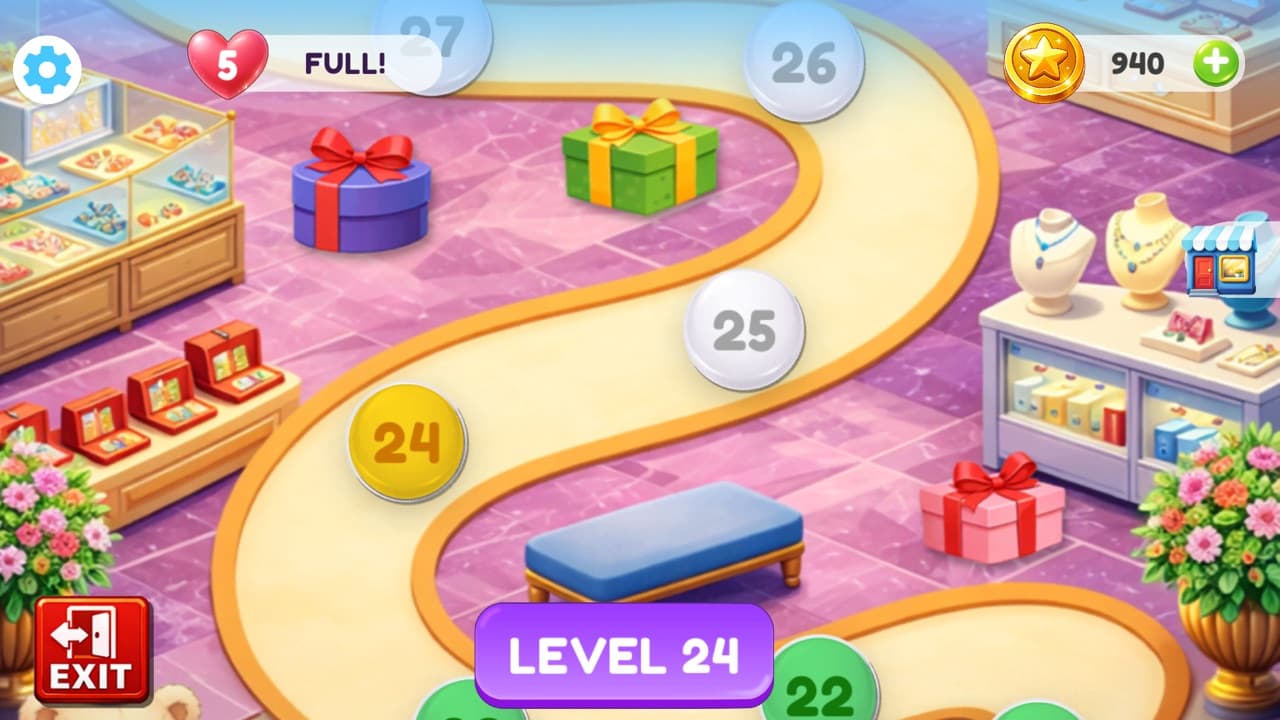
Levels 1 to 3 have 4 cards. Every three levels add two more, up to 28 cards on levels 37 to 39, and levels 40 to 60 all have 30. Multiplying the thresholds by the number of cards gives the time you have.
| Cards | Levels | Three stars | Two stars | One star |
|---|---|---|---|---|
| 4 | 1 to 3 | 9 seconds | 16 seconds | 23 seconds |
| 10 | 10 to 12 | 22.5 seconds | 40 seconds | 57.5 seconds |
| 16 | 19 to 21 | 36 seconds | 64 seconds | 92 seconds |
| 20 | 25 to 27 | 45 seconds | 80 seconds | 115 seconds |
| 24 | 31 to 33 | 54 seconds | 96 seconds | 138 seconds |
| 30 | 40 to 60 | 67.5 seconds | 120 seconds | 172.5 seconds |
The budget grows in step with the table, but the difficulty does not. With 4 cards there are only two pairs to remember. With 30 there are fifteen, and you will see many cards before their partners turn up. The big levels are where three stars are won or lost.
The Clock Starts Before You Do
The timer starts when the level begins, not on your first flip. It is already running while the cards are being laid out, which takes a second or so. Any time you spend looking at the backs of the cards is time gone, so start flipping the moment they appear.
The other fixed cost is built into every turn. When you turn over your second card, the table locks for one second while the game compares the pair, and taps during that second are ignored. This happens whether the pair matches or not. As soon as the second is up you can tap again, even while the two cards are still turning back over.
So a level with 30 cards cannot be finished in fewer than 15 turns, and those 15 turns contain 15 seconds of waiting that no amount of skill removes. Seen the other way round, the three-star budget comes to 4.5 seconds per pair, of which one second is the lock. Every wrong pair costs at least one more.
A Routine That Fits the Budget
Speed in this game comes from not having to think about where to tap next. Decide on an order before the level starts and keep to it.
- Sweep the table in a fixed order, such as left to right along each row. Turn over two cards you have not seen yet.
- If they match, carry on with the next two unseen cards.
- If they do not match, check each of them against what you remember. If you have already seen the partner of one, take that pair on your next turn while the position is fresh.
- When the second card you turn over is the partner of one you saw earlier, finish the turn, then collect that pair straight away.
- Once every card has been seen, clear the remaining pairs from memory, nearest first.
A fixed sweep helps your memory as well as your hands. You remember a card as the third in the second row, in the order you met it, which is easier to recall than a position on a grid you scanned at random.
The cards are laid out as large as your screen allows, so the shape of the grid depends on your device. The rows and columns you get used to on a phone are not the ones you will see on a laptop.
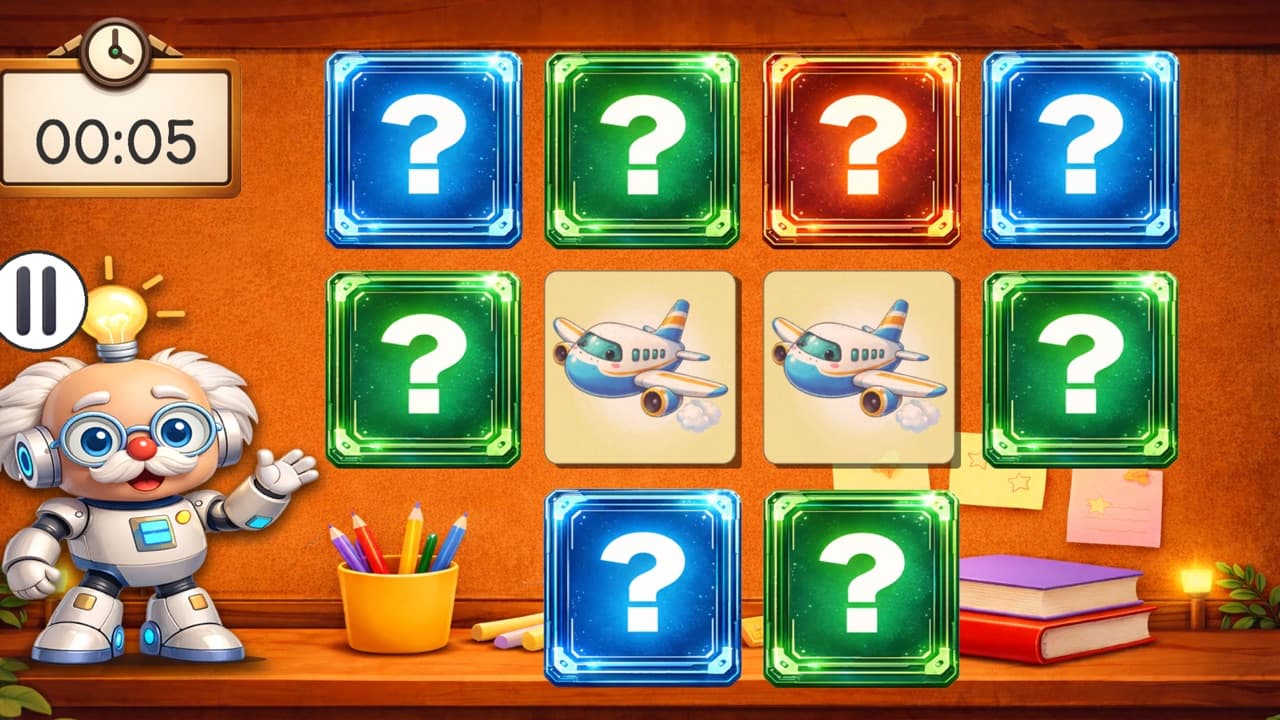
Two things that look like clues are not. The cards are shuffled afresh every time a level starts, so a layout you remember from the last attempt is gone. And the three colors of card back depend only on where a card lies on the table, not on the picture underneath. What does stay the same is the set of pictures: a given level always uses the same ones.
Where to Collect Stars First
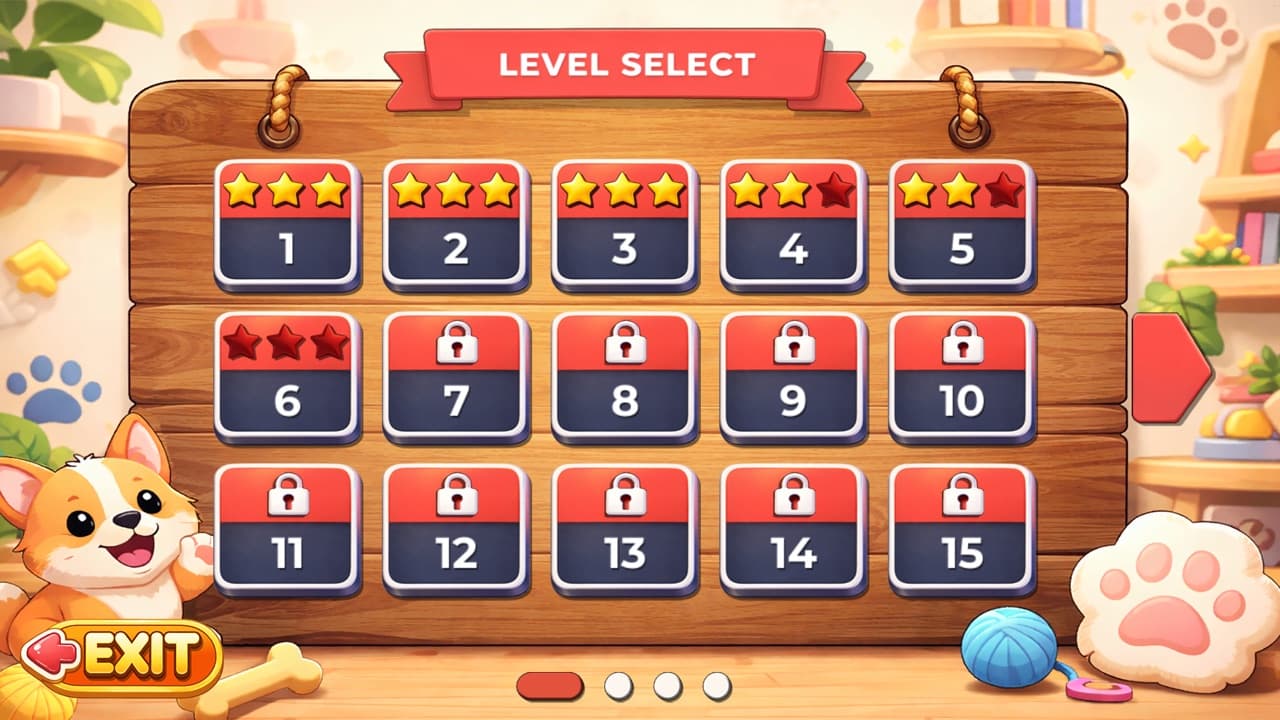
Your leaderboard score is the total number of stars you hold, up to 180 across the 60 levels. The game keeps your best result on every level, so a slower replay changes nothing and a faster one raises your total.
That makes the early levels the place to start: with only two or three pairs on the table there is very little to remember. The twenty-one levels with 30 cards hold more than a third of all the stars in the game, and they all have the same number of cards, so practice on one carries over to the rest.
If a run starts badly, with several wrong pairs in the first few turns, open the pause menu and restart. The clock and the turn count go back to zero and the cards are shuffled again, as often as you like. The timer also stops while the game is paused.