Music Blast: Timing Windows, Long Notes and Why Early Beats Late
Published by the Havfun team
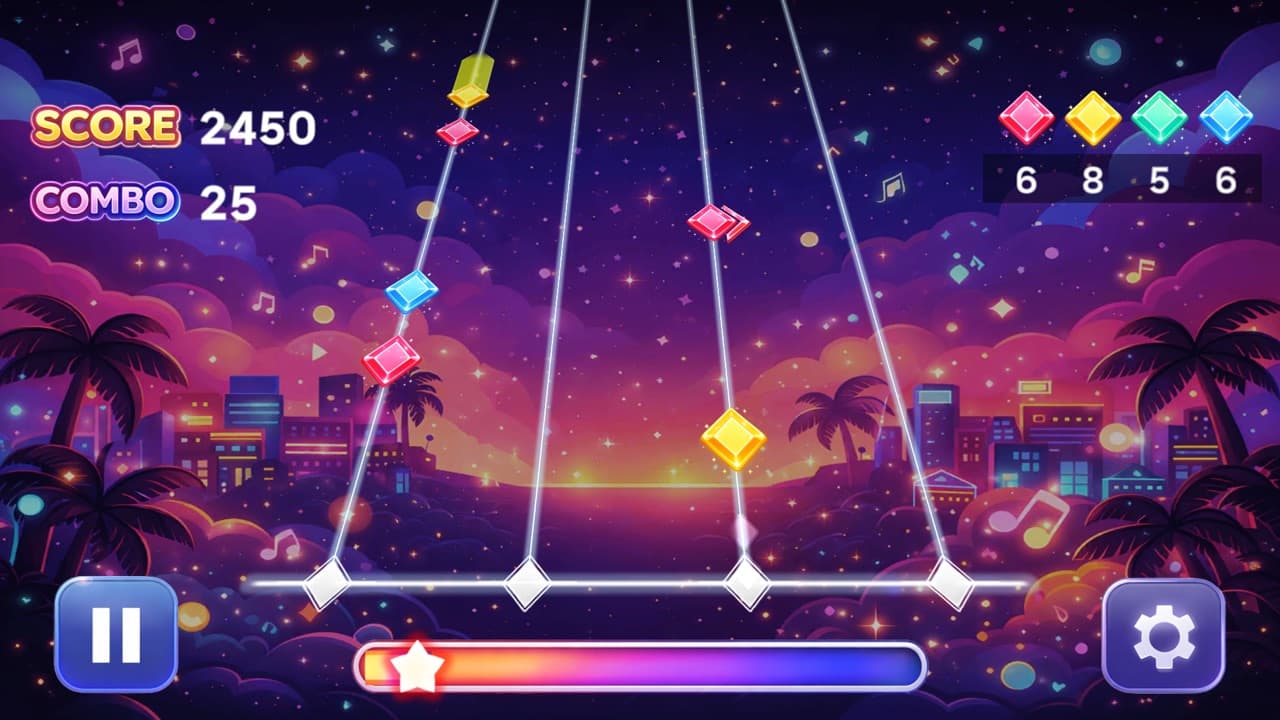
Music Blast can't be failed. Every song plays to the end whatever you do, and the only question is how many points you have when it stops. That makes it a relaxed game to pick up and a precise one to master.
The scoring is simple, and a few details of how hits are judged decide most of your score.
How a Hit Is Judged
The game looks at how far a note is from the line at the moment you press. All five songs run at the same tempo, so notes travel at the same speed in every song and the timing feels the same throughout.
| When you press | Result | Points |
|---|---|---|
| From about 0.6 seconds early to about 0.2 seconds early | OK | 90 |
| From about 0.2 seconds early to just after the line | Perfect | 100 |
| More than about 0.2 seconds after the line | Miss. The note can no longer be hit | 0 |
Two things stand out. The Perfect window is wide, and an OK costs you only 10 points. Then there is the shape of it: you can be more than half a second early and still score 90, but there is no such thing as a late OK. A note that has gone past the line is gone.
So when you are unsure, press early. And do not chase precision at the cost of rhythm. One missed note loses 100 points, as much as ten OKs.
What Does Not Count
- Your combo. It is shown on screen and reset by a miss, but it is not part of the score.
- A miss beyond the note itself. There is no extra penalty.
- A tap on an empty line or the wrong line. Nothing happens.
The last of these does not make mashing a good idea. A tap that catches a note as it first comes into range scores an early OK when it could have been a Perfect, and on a long note it starts a hold you are not ready to keep.
Long Notes
A long note is judged once, at the moment you press its head, and scores 100 or 90 like any other note. You then have to keep holding until the tail has passed the line. Let go early and the note scores nothing and your combo is reset.
Holding for too long costs nothing, so there is no reason to cut it fine. Keep your finger down until the tail has clearly gone.
You never have to play another line while you are holding. After a long note begins, the game leaves a gap of nearly a second and a half before the next note of any kind.
About 8 notes in 100 are long notes.
Swipe Notes
A swipe note is two actions. Pressing the line at the right moment is what gets judged. The direction then has to arrive before the note leaves the line.
- On a keyboard, press the line key and the left or right arrow. The arrow only has to be down, so you can press it a moment before the line key.
- On a touch screen, start the touch on the line and slide toward the arrow. A slide of a few millimetres is enough, and it is measured from where your finger landed.
- Swipes only ever go left or right, and about 12 notes in 100 are swipes.
Why No Two Plays Are the Same
The rhythm of a song is fixed, but the line each note falls on is drawn at random every time the song starts, and so is the choice of which notes become long notes or swipes. The same line can come up several times in a row. There are never two notes at once.
Because of this there is nothing to memorize, and practice pays off as general skill, not as knowledge of one song. It also means the number of notes in a song changes a little from play to play, since a long note pushes out the notes that would have followed it. A play with fewer long notes has more points on offer, so replaying a song can raise your best even when you play no better.
Each note is on its way for 5 seconds before it reaches the line. Read ahead, especially for swipes.
The Five Songs and the Leaderboard
The top score for a song is 100 points for every note in it, so longer songs are worth more.
| Song | Length |
|---|---|
| Waves Edge | 2 minutes 20 seconds |
| Neon Alley | 2 minutes 33 seconds |
| One More Coin | 2 minutes 54 seconds |
| Arcade Core | 3 minutes 2 seconds |
| Sparkle Tap Dance | 3 minutes 19 seconds |
The leaderboard adds together your best score on each of the five songs. A song you have never finished adds nothing, so play all five once before you go back to improve any of them. After that the long songs are where your total has the most room to grow.
A score is recorded only when a song plays through to the end. If you quit from the pause menu, that play is not saved. Resuming from pause gives you a count of three before the notes move again.
A Short Checklist
- Play every song once to put all five on the board.
- Press a little early when in doubt, never late.
- Hold long notes until the tail is gone.
- On swipes, think of the line first and the direction second.
- Replay the long songs. Each play deals a new set of notes, and some are worth more than others.