Police Shooting: Why One Long Streak Beats Fast Shooting
Published by the Havfun team
Police Shooting looks like a test of speed. Targets pop up, you shoot them, the clock runs down. Players who treat it that way tend to finish with a few thousand points and wonder how the top of the leaderboard got so far ahead.
The answer is in how hits are counted. Once you see the arithmetic, the right way to play becomes obvious, and it is slower than you would expect.
What a Hit Is Worth
A hit scores 100 points plus 100 for every hit already in your streak. The first is worth 100, the second 200, the third 300, and so on without a cap. Your total for an unbroken streak therefore grows much faster than the number of hits.
| Hits in a row | Last hit is worth | Total for the streak |
|---|---|---|
| 5 | 500 | 1,500 |
| 10 | 1,000 | 5,500 |
| 15 | 1,500 | 12,000 |
| 20 | 2,000 | 21,000 |
| 30 | 3,000 | 46,500 |
Compare two rounds with the same twenty hits. In one you break the streak halfway and score two streaks of ten: 11,000 points. In the other you keep it whole: 21,000. Nothing else you can do in this game is worth as much as not breaking the streak.
All three kinds of target, the round bullseye and the two silhouettes, score the same. There is no bonus for hitting the center of a target and none for speed.
| Longer streaks | Total |
|---|---|
| 40 hits in a row | 82,000 |
| 50 hits in a row | 127,500 |
The Only Thing That Breaks a Streak
A streak ends when a shot hits the background. That shot also takes one second off the clock. Nothing else resets it.
In particular, a target that drops back down before you get to it costs you nothing. Each target stays up for 2 seconds, and if it leaves unshot your streak is exactly where it was. This is the most useful fact in the game, because it means that not shooting is always safe.
- If the crosshair is not on the target yet, do not fire. Let it go.
- If a target appears at the far side of the range with little time left on it, let it go.
- If you are not sure whether you tapped the target or the wall behind it, slow down. One miss at a streak of 15 throws away a next hit worth 1,600 points and sends you back to 100.
Three Rows of Targets
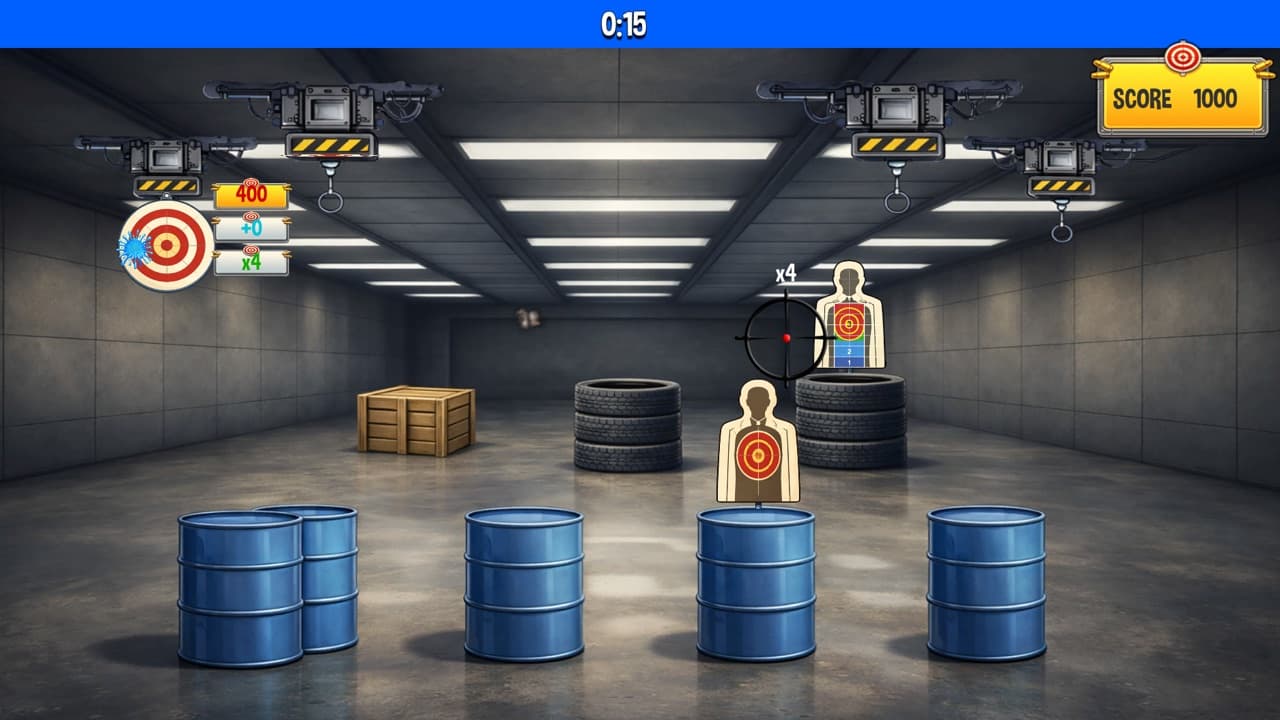
A new target appears about every 0.7 seconds at one of 11 spots, and the pace never changes. The game does not speed up as a round goes on, so the last ten seconds are no harder than the first.
The spots are arranged in three rows, and each row always shows the same kind of target.
| Row | Target | What to know |
|---|---|---|
| Top, 4 spots | Round bullseye, hanging | The widest target on the range |
| Middle, 3 spots | Silhouette | The narrowest: a little over half the width of a bullseye |
| Bottom, 4 spots | Silhouette | Slightly wider than the middle row, and the tallest |
A shot counts if it lands anywhere inside the box around a target. The middle row is where streaks most often end, because those targets leave the least room for error. When you are protecting a long streak, a bullseye in the top row is a safer shot than a silhouette in the middle.
Several targets are up at once, so you do not have to take them in the order they appeared. Shoot the one nearest your crosshair first and move outward. You can fire four times a second at most.
Ammo Crates Are the Clock
A round starts with only 15 seconds, and every ammo crate you shoot adds 5. A crate gives no points and does not touch your streak. It is pure time.
- The first crate appears a few seconds into the round, at one of three spots.
- A crate you shoot is followed by the next one 8 seconds later at the earliest.
- A crate you leave alone disappears after 10 seconds, and then the wait for the next is longer still, about 13 seconds in all.
- A crate sits in front of the targets. If one overlaps a target, your shot goes to the crate.
These numbers set the length of every round. Each crate gives back 5 seconds but takes at least 8 to come round again, so the clock always loses in the end. A round in which you shoot every crate the moment it appears has room for four of them and lasts about 35 seconds. Miss one and you are down to about 30.
That makes each crate worth more than it looks. Five extra seconds late in a good round is several targets at thousands of points each, so a crate is always worth one careful shot. Line it up before you fire, because a shot that lands beside it hits the background.
A Way to Play a Round
- Rest the crosshair near the middle of the range so that no spot is far away.
- Take the first few targets carefully. The points are small here, but the streak you are building is what the rest of the round is multiplied by.
- From then on, shoot only when the crosshair is on the target. Skip anything doubtful.
- When a crate appears, finish your current shot and take the crate next. The sooner it is shot, the sooner the following one can arrive.
- As the clock gets low, resist the urge to speed up. A miss costs a second as well as the streak, so hurrying shortens the round twice over.
On a phone, your finger hides the target at the moment you tap. Use a fingertip and tap the middle of the target, not its edge. On a computer you move a crosshair with the mouse and can see exactly where the shot will land before you click.
What Goes on the Leaderboard
Your score is the total from a single round, and the leaderboard keeps your best one. There is no pause button and a round cannot be resumed, so a round that loses its streak early is not worth nursing. Finish it or let the clock run out, press Restart on the result screen and start a clean one.