Triple Sort: How to Keep the Tray From Filling Up
Published by the Havfun team
Triple Sort has one way to lose. The tray fills up and the level is over. There is no timer on any of the 200 levels, so every loss comes down to a tile you took before you were ready for it.
This guide looks at how the tray counts, how the pile is dealt and what that tells you about which tile to take next.
Seven Slots, but Only Six to Spare
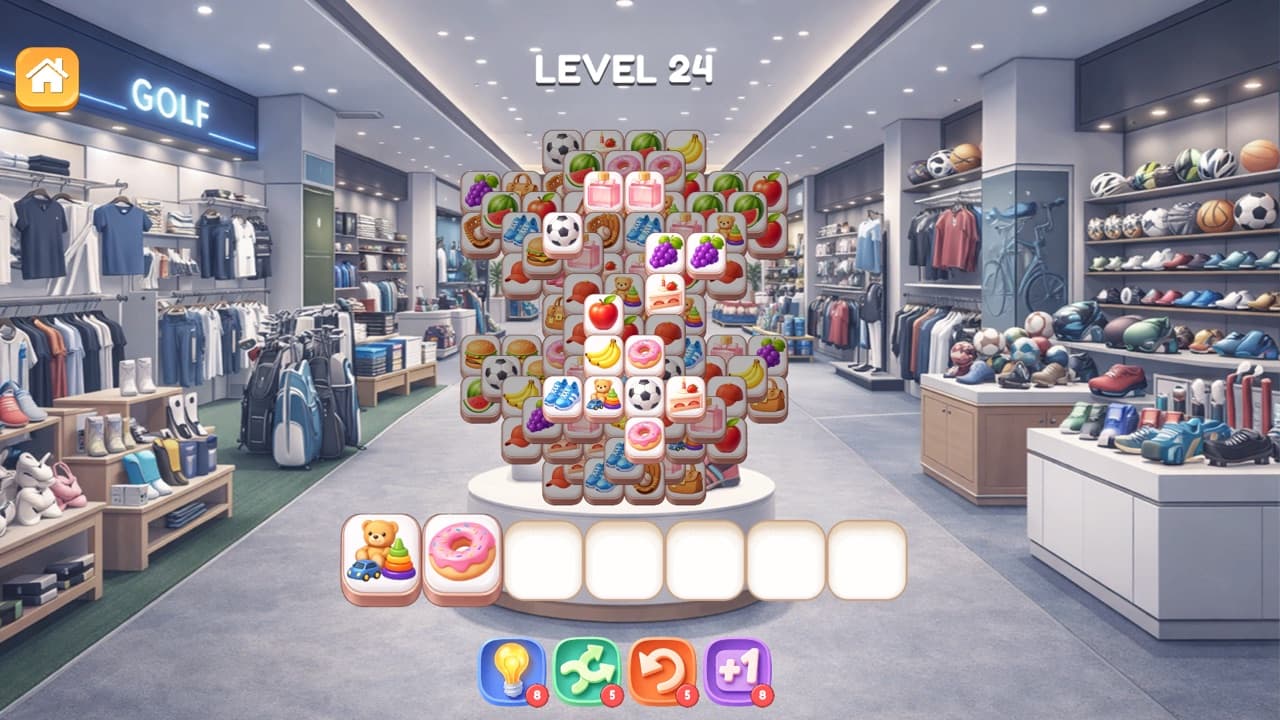
The tray has seven slots, and three matching tiles in it disappear. The game checks for a loss as each tile arrives: a tile that lands in the last slot is safe only if it completes a set of three. In practice you can hold six tiles that have not matched. The seventh has to finish a set.
It helps to count the tray in kinds instead of tiles. A pair needs one more tile to clear. A single needs two. Six slots can carry three pairs, and then any third tile of those three kinds is safe. Six singles of six different kinds is the worst tray there is: nothing you can take next will clear anything.
- Finish pairs before you start new kinds.
- Before you take a single, find at least one of its partners among the tiles you can reach.
- A tile you take always slides in beside its own kind, so the tray shows your pairs and singles at a glance. Read it before every tap.
How the Pile Is Dealt
The shape of each level's pile is fixed, but the pictures are not. Which picture sits on which tile is dealt again every time the level loads, including after a retry. You cannot learn a level by heart, and a bad deal is gone the next time you try.
The deal does follow a rule that you can use. The three tiles of a set are placed close together in depth. The first goes into the highest layer with room, and the other two go into the same layer or, less often, one or two layers further down. They are never placed deeper than that.
So when you can see one tile of a kind on top of the pile, its partners are almost always in that layer or the two beneath it. If you can see two of a kind, the third is close. Digging straight down in one place rarely finds a match for a tile near the surface. Clearing sideways across the upper layers does.
Each level also uses only some of the 15 kinds of tile, between 7 and 15 of them, chosen at random for each attempt. This changes the feel of a level more than its size does. Level 100 spreads 38 sets over 8 kinds, so matches are everywhere. Level 99 has the same 38 sets over all 15 kinds, and with only six spare slots you can't hold one of each.
Levels Don't Simply Get Bigger
Size is not a steady climb. The largest pile in the game is on level 141, with 62 sets, which is 186 tiles. The deepest is level 89, with 14 layers. Level 24 already has 55 sets, while level 138 has only 14 and the final level, 200, has 28. If a level feels much harder than the one before, it probably is, and the next may well be easier.
The Four Special Tiles
Special tiles appear on 24 levels, always one kind per level, and none after level 97.
| Tile | Levels | How it behaves |
|---|---|---|
| Unknown | 6, 19, 34, 50, 66, 82 | Its picture stays hidden until the tile is in the tray. Taking one is a blind draw that uses a slot |
| Crate | 9, 22, 39, 54, 70, 88 | It can't be tapped. It opens when you collect another tile after the crate is already uncovered. The tap that uncovers it does not open it |
| Ice | 12, 25, 42, 59, 74, 92 | It cracks once for each tile you collect while the ice is uncovered and comes free on the third. A Link pair counts as two |
| Link | 15, 29, 46, 62, 78, 97 | Two neighboring tiles in the same layer that are taken together. Both must be uncovered, and the pair uses two slots |
Two of these reward doing things early. Uncover ice as soon as you can, because it only thaws while it is uncovered, and every tile you collect afterward does part of the work. Uncover crates early for the same reason: the very next tile you take opens them.
The other two are about tray space. Take an Unknown tile only when you could live with a new single. Take a Link pair only when you have two slots for it, or when one of its tiles finishes a set.
What the Power-Ups Really Do
You start with three of each, and all four work from level 1.
- Undo returns the tile at the right-hand end of the tray to the pile. Because tiles sit beside their own kind, that is not always the tile you tapped last.
- Hint completes the kind you hold most of. It pulls the missing tiles from anywhere in the pile, buried ones included, and frees them from ice, crates and links on the way. If the tray doesn't have room for the tiles it needs, it does nothing and isn't used up.
- Shuffle moves every tile still in the pile to a new position, including the buried ones. Link pairs stay where they are, and the tray is not touched.
- Extra Slot adds an eighth slot. It can be used once per level.
Hint is the strongest of the four when the tile you need is at the bottom of the pile. Shuffle is the one to use when the tray is nearly full and nothing on the surface matches it.
There is a price. A level cleared with any power-up moves you on in the game but does not count on the leaderboard, which records the highest level you have cleared without them. A level you first beat with help can be replayed from the map and cleared clean later.
Coins and Lives
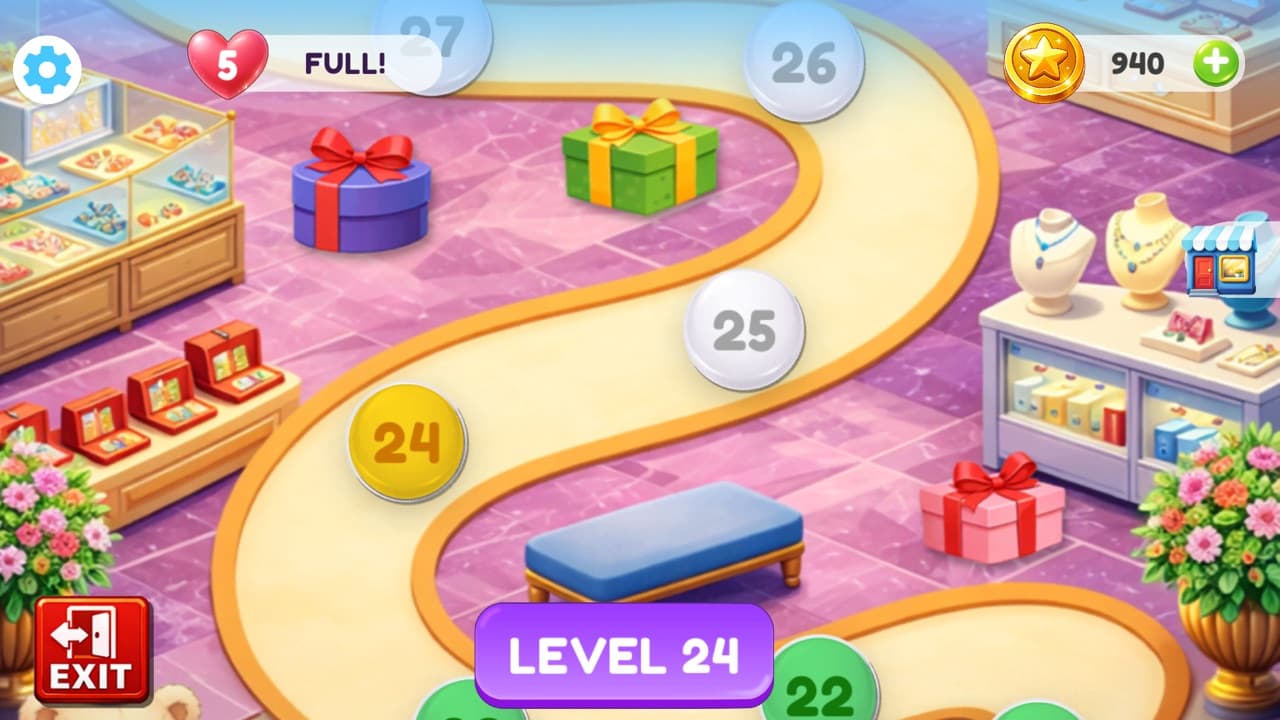
Clearing a level pays 20 coins the first time and 5 on a replay, and the store gives 150 coins once every 60 minutes. For 100 coins you get 5 more Undo, Shuffle or Hint, or 3 Extra Slots. The hourly gift is worth more than seven first-time clears, so collect it whenever you open the game.
You have 5 lives. One is taken the moment a level fails or you confirm that you want to quit it, and one returns every 5 minutes. A level in progress is not saved, so closing the game halfway means starting that level again from a new deal.